Office Address
123/A, Miranda City Likaoli
Prikano, Dope
Phone Number
+0989 7876 9865 9
+(090) 8765 86543 85
Email Address
info@example.com
example.mail@hum.com
123/A, Miranda City Likaoli
Prikano, Dope
+0989 7876 9865 9
+(090) 8765 86543 85
info@example.com
example.mail@hum.com








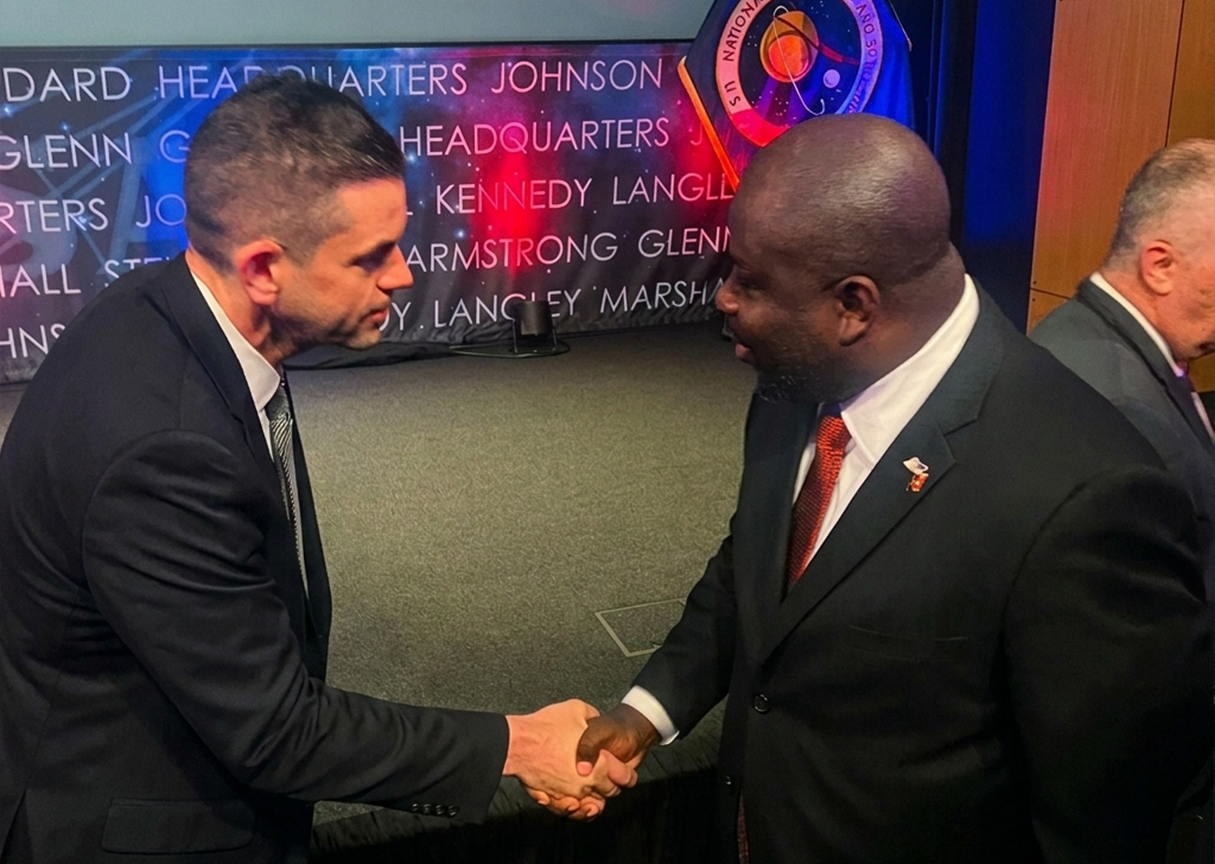
The launch was attended by an Angolan delegation led by the Director General of GGPEN, Zolana João, highlighting the country’s active commitment to major milestones in global space exploration.
After successfully completing its mission objectives, including a lunar trajectory, the Orion capsule returned to Earth on April 10, 2026, concluding with a safe reentry and ocean splashdown, where the astronauts were recovered by NASA teams, successfully ending the mission.
This milestone reaffirms technological advancement and international cooperation within the Artemis Program, which aims to establish a sustainable human presence on the Moon and prepare future missions to Mars, including Artemis III.
Angola was present at this historic moment, reinforcing its growing position within the international space ecosystem.
As a signatory of the Artemis Accords, Angola is part of a group of countries committed to the peaceful, sustainable, and collaborative use of outer space, taking an active role in discussions shaping the new lunar economy and global space governance.
It is important to highlight that these advancements result from the strategic vision and continuous efforts of the Ministry of Telecommunications, Information Technologies and Social Communication (MINTTICS) and the Government of Angola, which have been promoting the development of the space sector as a pillar of innovation, digital transformation, and sustainable national growth.
Concrete opportunities and practical projects for Angola
Angola’s participation in this new cycle of space exploration, particularly in the context of Artemis III, opens direct opportunities for collaboration with some of the world’s leading space agencies, enabling:
• Direct collaboration with international agencies such as NASA and its partners in lunar exploration programs
• Participation in applied, hands-on projects, from satellite communications and data processing to technology solutions based on space infrastructure
• Integration of Angolan technical teams into international initiatives, promoting real-world experience in large-scale projects
• Development of local solutions with global impact, using acquired knowledge to address national challenges
• Creation of innovation centers and technology hubs focused on space and digital applications
• Opportunities for young engineers and startups, providing access to real, not only academic, projects
• Direct technology transfer, accelerating the country’s industrial and technological development
• Preparation for participation in the lunar economy, including areas such as logistics, data, operations, and services
Angola’s active presence and engagement in this context reaffirm the Executive’s commitment to positioning the country as a relevant actor in the global space economy, placing youth at the center of this transformation and ensuring that the benefits of this new era translate into real, practical, and sustainable opportunities for national development.